New Romantic: An Interview With Jesse Boykins III
A year after his time at the 2011 Red Bull Music Academy in Madrid, soul singer and songwriter Jesse Boykins III is set to release his new album with producer/MC Melo-X Zulu Guru on Ninja Tune. Phillip Mlynar meets the man ushering in a new era of romance, and gets the inside scoop on serial collaborations, embracing femininity and table manners when dining with royalty.
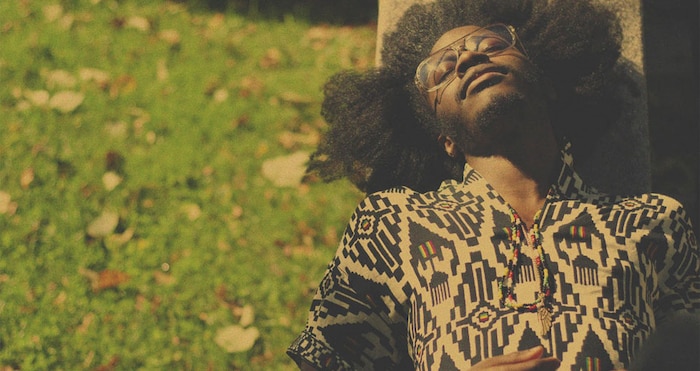
“I went to a private dinner with Prince,” confides Jesse Boykins III while sitting at a bar in Bushwick, Brooklyn. It’s early in the afternoon and Boykins, a grandiosely-named 27 year-old soul singer and songwriter, is talking about a fantasy wishlist of producers he’d like to work with when Prince’s name comes up. He wonders about the dynamic his improbable ensemble would create in the studio; the ego-bustin’ line-up also includes Quincy Jones, Pharrell and Chad from The Neptunes, Q-Tip and Ahmir ‘?uestlove’ Thompson. Then he cracks a joke about how he wouldn’t be afraid to yell at any of the super-producers who weren’t following his directions, and coyly lets slip that Prince was “pretty cool” when they met. Fruit flies amble around in the air and the bar veers toward the divier side, but clad in his thrift-store get-up Boykins affects a casual cool as he tells his Purple-hued anecdote.
“A friend of mine hit me up and invited me to dinner with Prince,” he says, before adding that his female friend is also a model. “I thought it would be some big dinner party with a lot of people, but it ended up being only six of us in the basement of this restaurant called Butter in Soho at like one o’clock in the morning on a Wednesday. We get to the spot and there was a DJ, the chefs, the whole staff, but the restaurant is closed. We sit down and my friend is like, ‘Don’t use your phone in Prince’s presence; don’t look Prince in the eye; don’t curse in Prince’s presence; don’t order meat in Prince’s presence.’ It was pretty random, but fuckin’ cool.”
Prince entered the basement wearing a blazer with diamonds on it, walked down the staircase with a girl on his arm and thanked him for turning up on such short notice.
At that point, Boykins remembers, Prince entered the basement wearing a blazer with diamonds on it, walked down the staircase with a girl on his arm and thanked him for turning up on such short notice. The realisation hit him: “I was like, ‘Fuck, you’re Prince!’”
Then, abruptly, Prince walked over, sat at another table and ordered his food from the chef. When subsequently asked by the chef what he and his friend wanted to eat, Boykins says he decided to plump for chicken alfredo, despite the earlier warning. “The chef says, ‘Prince doesn’t eat meat so I usually don’t cook meat.’ I told her, no disrespect to Prince but I’m not sitting at his table and I want some chicken alfredo. She walks away and Prince beckons us over to his table.
“We’re sitting in a booth with Prince and we stayed there for three hours,” he continues. “We talked about Old Spice commercials, the Miami Heat and Chris Bosh, his views on being an artist. It was cool, but I was so afraid to talk to him I had to force myself to say something; I think I asked him one question about whether he was a vegetarian. He said he was and I asked him how long. He said eight years. I asked if he ate fish, though. He said he did, but only one kind. I asked what kind. He said salmon.” Boykins pauses, lets out a laugh, then says, “That was mine and Prince’s conversation! That was our bond!”
At that point the food arrived, although Prince didn’t touch any of the lavish spread, preferring instead to very carefully pick up a piece of bread, smear some butter on it, and decide he wasn’t hungry. It was the signal for the end of a night that Boykins is happy to look back on and refer to as “my Prince story.”
When re-telling his meeting with Prince, Boykins’ initial burst of excitement is quickly tempered, and he ends up talking as if mentioning a run-in with a musical peer, despite the superstar-sized chasm between their profiles. As he lounges at the bar for an hour or so Prince’s name comes up frequently, and there’s something of a kindred-spirited vibe about the idea of the Romantic Movement Boykins is attempting to spearhead and Prince’s own New Power Generation. (The Romantic Movement is a collective of New York-centric musicians, rappers, poets and singers who gel together over a philosophy hooked around the importance and ideal of romance conveyed through music.)
The latest way-point on Boykins’ journey is the release of Zulu Guru, an album cut in tandem with the Brooklyn-based rapper Melo-X and released on the expansive NinjaTune label. As the 15 tracks that make up the project unfurl, the sound dips and darts away from its modern soul base to flirt with dance music tempos, codas of African rhythms and luxurious swathes of synths that swaddle songs in a warm atmospheric glaze only for the backdrop to cut out completely as a spoken-word poetry performance takes centre-stage. By the time the album finishes, it leaves the impression of Boykins as a modern band-leader decked out in vintage wares and sporting homemade beads and bracelets given to him by his followers. (He runs his fingers over a bracelet on his left wrist and says female fans are always making trinkets for him.)
Machinedrum & Jesse Boykins III “In The Dust” (from Want To 1 2?)
Boykins is enthusiastic about the potential of living a creative life hooked on collaboration. His debut EP Dopamine was released in 2008, but he talks more excitedly about collaborating with the then-aspiring New York City rappers Theophilus London and Mickey Factz and producer Machinedrum for the latter’s Want To 1 2? album on the now-defunct Normrex label in 2009. He and Machinedrum used to live blocks away from each other in the Bedford-Stuyvesant section of Brooklyn and would spend afternoons combing through each other’s record collections looking for inspiration and curios. Likewise, he gushes about future plans he has with Jeremy Most (who’s best known for producing for singer-songwriter Emily King), and says that from his experience club-king Sinden is “a total ideas guy.”
Musicians can be inherently selfish when it comes to claiming creative spoils. A producer can craft a monster track that becomes a radio anthem and the singer’s ego will usually declare success as being solely down to their inspired vocal performance. Boykins is different. He’s not short of confidence in his own ability, but he becomes most gleeful when detailing his theories on working with other musicians. He says that his personal approach to songwriting involves sending an early idea to his band and letting them add or take from his initial sketch. When they return their version to him, he’ll readdress the song, hopefully finding himself newly inspired by the suggestions of others.
“I learn a lot from women. Not even on some relationship shit, but things to pay attention to. My song-writing is my knowledge of things I’ve learned.”
Working outside of his Romantic Movement family, Boykins embraces an equally give-and-take approach. At some point in the conversation he talks about appreciating Coldplay’s “Sparks” years after he first heard it in college. He tells an anecdote about once seeing lead singer Chris Martin on the street in Manhattan. Asked how he’d handle a collaboration with Martin he says, “First thing I’d do is ask him to play me the top five songs by artists dead or alive that he lives for. Then I’d play him mine. Then I’d ask him about the most fucked-up way that he got his heart-broken and we’ll start from there.” At that point, he adds, they’d probably come up with a song’s piano line.
Boykins’ unabashed willingness to pool resources with other musicians might be the defining trait of his work. When his vocals make it to the finished version of a song, they take on a peculiarly alluring style. On Zulu Guru, his voice is less that of a lead singer and more another instrument in a grand and interweaving ensemble. At times his words seem to be processed to sound as if they’re submerged in water (“The Perfect Blues”) or echoing down from a sparse mountaintop (“Searching Her Ways”). It takes a grand ego to step back from the spotlight for the collective good.
Singing from the sidelines in this way also runs through Boykins’ songwriting. Setting himself apart from the commercial side of the modern R&B world, he says he has a sincere commitment to penning songs that embrace the feminine side: “I learn a lot from women. Not even on some relationship shit, but things to pay attention to. My song-writing is my knowledge of things I’ve learned.
“Pop music is so ego-driven right now,” he continues. “Like the man doesn’t need the girl; there’s so many girls in this world type shit, so who cares? But it shouldn’t be like that. Growing up in the 90s I was listening to Jagged Edge and Boyz II Men. Before that it was Marvin [Gaye] and Stevie [Wonder]; take it left and it was Pink Floyd and Fleetwood Mac. It was listening to love, not saying love doesn’t exist. I don’t get it. As far as why this generation under me thinks like that, I don’t know. I always give my best to shed light on how great woman is.”
Then for a final time this afternoon Boykins slips into the purple zone. “I learned that Prince is a masculine dude but also a feminine dude,” he says. “It’s okay to be both at the same time, to have that balance. A lot of dudes just wanna beat their chest but won’t embrace any femininity. They miss out on a lot.”